

Quick Overview
- An ignition interlock device is a breath-testing unit wired into your vehicle. The car will not start if it detects alcohol above the set limit
- Drivers convicted of a Criminal Code impaired driving offence must use one before full driving privileges return
- Minimum interlock periods are 1 year for a first offence and 3 years for a second, with longer periods for later offences
- Some first-time offenders can enter the program sooner through a reduced suspension option, but the timing is tight
- You pay for the device yourself. Fees are monthly, and missed servicing or violations bring extra charges and longer terms
- The licence condition applies to every vehicle you drive, including a work vehicle
- Removing the device requires more than waiting out the calendar, including a medical form and completion of Back on Track
What the Device Does
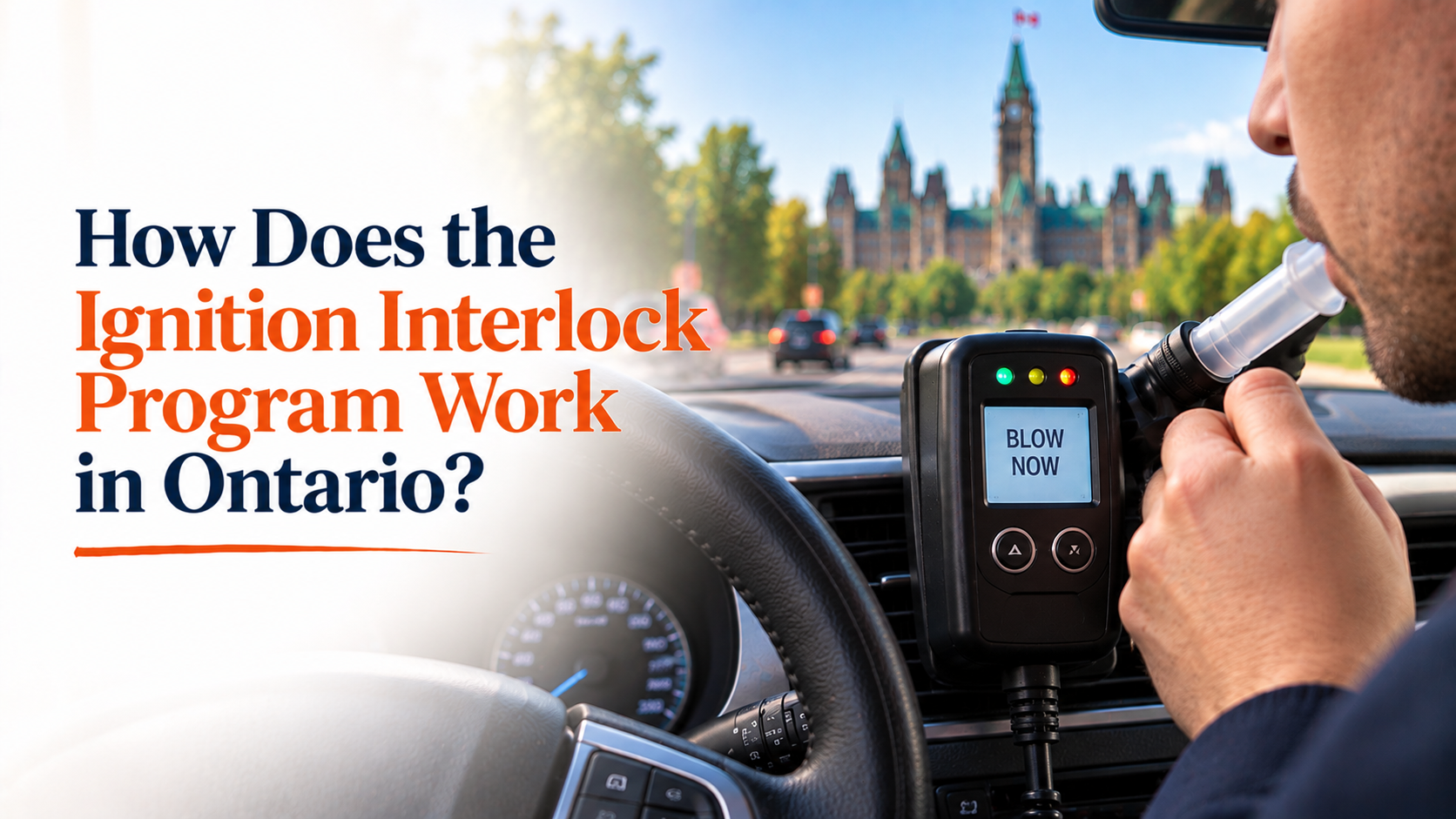
An ignition interlock device is a breath-screening unit connected to the vehicle’s ignition. Before the engine starts, you blow into a handset. If the reading is above the pre-set limit, the vehicle will not start. In Ontario, a reading over 0.02 BAC counts as a performance failure (Ontario.ca).
Once you are driving, the device asks for further breath samples at random intervals. These rolling retests are meant to stop someone else from blowing for you to start the car. If you fail a retest or miss one, the engine does not shut off, because that would create a hazard on the road. Instead, the device warns you, records the event, and sets off the horn and flashing lights until you turn the ignition off. Every start attempt, failed test, missed retest and sign of tampering is logged, and the vendor downloads that data and sends it to the Ministry of Transportation (MTO) (Ontario.ca).
The Legal Framework
Two layers of law are involved. At the federal level, a driver convicted of an impaired driving offence under the Criminal Code receives a driving prohibition (Criminal Code, s. 320.24). At the provincial level, the Highway Traffic Act and O. Reg. 287/08 set the rules for the interlock program. Under the regulation, a participant’s licence carries a condition prohibiting them from driving any vehicle that does not have an approved device installed.
Who Has to Install a Device
Ontario’s interlock requirement applies to drivers convicted of a Criminal Code impaired driving offence, which includes operating while impaired and having a blood alcohol concentration of 80 mg or more, as well as refusing a lawful demand for a sample (Ontario.ca). Our guide to refusing a breathalyzer test in Ontario explains why a refusal can lead to the same result as a conviction for driving over the limit.
The minimum interlock periods listed by the ministry are:
| Situation | Minimum interlock period |
| First Criminal Code conviction | 1 year |
| Second Criminal Code conviction | 3 years |
| Third or later conviction | 6 years, if licence reinstatement is ever permitted |
| Repeat administrative (warn range) suspensions | 6 months |
The interlock period usually follows the driving prohibition. Some drivers who accumulate repeated warn-range suspensions can also end up with an interlock condition. Our article on the 90-day roadside licence suspension explains how roadside suspensions work and how they differ from a criminal case.
How a Driver Enters the Program
Section 320.24 of the Criminal Code allows a province to put an offender into an interlock program before the full prohibition ends, once a minimum period without driving has passed. Ontario uses this through its Reduced Suspension with Ignition Interlock Conduct Review Program.
For an eligible first-time offender, the shortest route requires pleading guilty, being sentenced and receiving the prohibition order within 90 days of the offence. That path leads to a 3-month hard suspension followed by at least 9 months with the device. Offenders who do not resolve the matter in that window, and second-time offenders, face longer waiting periods before they can enter the program. That timeline can influence decisions about the criminal case itself, so it is worth getting advice before any plea. An Ottawa Impaired Driving Lawyers team can explain how the 90-day window fits with the strength of the Crown’s case.
Once eligible, the driver generally needs to:
- Complete the assessment part of the Back on Track remedial measures program
- Pay any outstanding administrative penalties and the $281 licence reinstatement fee, and make sure other suspensions have ended
- Sign a lease with an approved interlock vendor
- Have the device installed by the vendor
How Long the Device Stays In
The minimum periods are in the table above, but a driver who breaks the rules will have the term extended. Under the ministry’s rules (Ontario.ca):
- Performance failure near the end of the term. For first-time offenders, a failure in the final 3 months adds 3 months. For repeat offenders, a failure in the final 6 months adds 6 months
- Program violation at any time (such as tampering, missing a service appointment or driving a vehicle without a device). The extension is 6 months for a first-time offender, 18 months for a second-time offender and 3 years for a repeat offender
What It Costs
The offender pays for everything, and the ministry does not list any assistance program. As an example of one approved vendor’s published prices, Smart Start Canada’s Ontario fee schedule lists the following, including taxes:
| Item | Cost |
| Monthly lease | $77.97 |
| MTO administrative fee | $7.50 per month |
| Installation and removal (standard vehicle) | $0 |
| Missed appointment | $113.00 |
| Violation reset or unlock code | $84.75 to $96.05 per incident |
| Early termination | $282.50 |
These figures can change, so check the vendor’s current schedule. The costs add up alongside the reinstatement fee and the fees for Back on Track, so ask the vendor for a full written estimate before you sign.
Rules While You Are in the Program
Service appointments. The regulation requires you to bring the vehicle to your vendor for inspection, maintenance and data download at least once every 60 days (O. Reg. 287/08). Missing one can lock the device and be recorded as a violation.
Performance failures and program violations. The ministry treats these differently. A performance failure is a failed start or a failed or missed retest. A program violation is a more serious breach, such as tampering with the device, asking another person to provide a breath sample, failing to install the device in time or driving a vehicle that does not have one (Ontario.ca).
Driving an unequipped vehicle. Doing so breaks your licence condition. It can bring a fine, a longer interlock term and impoundment of the vehicle, and the details are on the ministry’s program page.
Getting the Device Removed
Ontario introduced an incentive effective July 1, 2026. A driver who installs the device within 30 days of reinstatement, keeps a valid licence, and has no performance failures or program violations may qualify for early removal. For a first-time offender, that can mean 9 months instead of 1 year. For a second-time offender, it can mean 2 years instead of 3 (Ontario.ca).
Removal is not automatic. About six months before the condition is due to end, the MTO mails a Substance Use Assessment form. A physician, specialist or nurse practitioner must complete it and return it. You must also have completed the Back on Track program, and the ministry will review your vendor records for a clean history before authorizing removal.
Work and Everyday Life
The licence condition applies to any vehicle you drive. For someone who drives for work, that means an employer’s vehicle would need a device as well, or the driver cannot lawfully drive it. The same goes for borrowed vehicles, and anyone else who drives a vehicle with a device installed must also provide breath samples to start it. Anyone in this situation should discuss the practical details with the employer and the vendor early.
Effect on Impaired Driving Rates
The Ontario government has estimated that installing an interlock device can reduce the chance of a convicted impaired driver reoffending by up to 95 percent while the device is in use (Ontario Newsroom).
Key Deadlines
- 90 days from the offence: the window for a first-time offender to plead, be sentenced and receive a prohibition order to reach the shortest reduced suspension route
- 30 days from licence reinstatement: the device must be installed to stay eligible for the 2026 early removal incentive
- Every 60 days: maximum gap between service and data download appointments
- About 6 months before expiry: the ministry sends the Substance Use Assessment form
Getting Advice Before You Decide
Choices made early in an impaired driving case, especially about timing a plea, can affect how long a driver is off the road and how long the interlock condition lasts. LMS Lawyers advises Ottawa drivers facing impaired driving charges and licence consequences. You can contact an Impaired Driving Lawyer Ottawa at LMS to review your charge, the reduced suspension timeline and the program requirements.
FAQs
Does every impaired driving conviction lead to an ignition interlock requirement?
A Criminal Code impaired driving conviction leads to an interlock requirement before full driving privileges are restored. The minimum period depends on your record.
How long do I have to keep the device after a first conviction?
At least 1 year. If you qualify for the 2026 early removal incentive, it can be as short as 9 months.
Who pays for the device?
You do. The ministry does not list financial assistance for the program.
Can I drive my employer’s vehicle?
Only if it has an approved device installed. The condition applies to every vehicle you drive.
What happens if I fail a rolling retest?
The vehicle does not shut off. The horn sounds and the lights flash until you turn off the ignition, and the event is recorded. A failure near the end of your term can extend it.
Can someone else blow into the device for me?
No. Asking another person to provide a breath sample is a program violation and can extend your term by 6 months to 3 years.
Summary
The ignition interlock program requires drivers convicted of Criminal Code impaired driving offences to use a breath-testing device before full driving privileges return. The minimum term is 1 year for a first offence and 3 years for a second. First-time offenders can enter the program earlier by pleading and being sentenced within 90 days. The driver pays for the device, must attend service appointments at least every 60 days, and faces longer terms for failures or violations. A 2026 incentive allows early removal for compliant drivers, but removal still requires a medical form and completion of Back on Track. LMS Lawyers can review your charge and your options at any stage.
Sources
- Ontario.ca: Ignition Interlock Program
- Ontario.ca: Reduced Suspension with Ignition Interlock Conduct Review Program
- O. Reg. 287/08: Conduct Review Programs
- O. Reg. 287/08 (version 4)
- Criminal Code, s. 320.24 (Statutes.ca)
- Smart Start Canada: Ontario Program Fees
- Ontario Newsroom: Making Ontario’s Roads Safer
This article is intended for general information purposes only and describes federal and Ontario law as of October 2026. It does not constitute legal advice and does not create a lawyer-client relationship between LMS Lawyers and the reader. For advice specific to your situation, please consult a licensed lawyer.