
Quick Overview
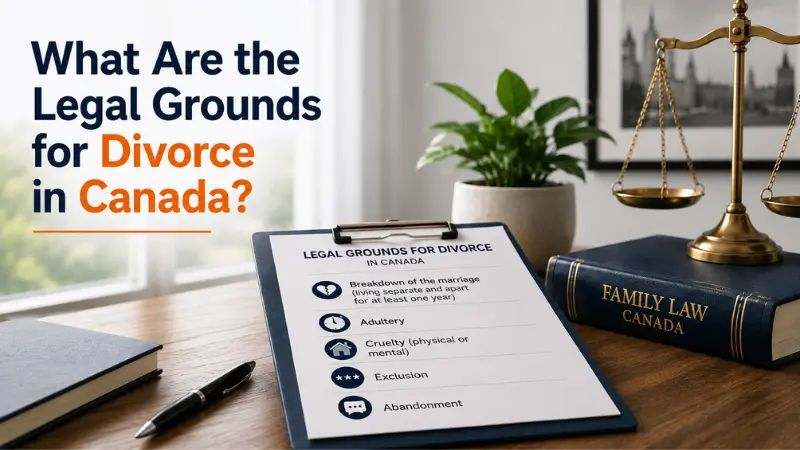
- Canada has just one legal ground for divorce, a breakdown of the marriage, but three separate ways to prove it
- Living separate and apart for one year is by far the most common route, accounting for the overwhelming majority of Canadian divorces
- The separation clock starts the moment one spouse decides to end things and acts on it, the other spouse’s agreement isn’t required
- Couples can be legally separated while still living under the same roof, courts look at specific objective factors to determine this
- Adultery and cruelty exist as faster alternatives, but they carry a much higher evidentiary burden and are rarely used
- None of these grounds affect how property, support, or parenting get decided, those run on entirely separate legal tracks
Just One Ground, Three Ways to Prove It
Canadian divorce law is simpler at its core than most people expect. Under the federal Divorce Act, there’s exactly one legal ground for divorce, a breakdown of the marriage. Where it gets more specific is in how that breakdown actually gets proven, and the law recognizes three distinct paths. Living separate and apart for at least a year is the first and most common. Adultery is the second. Cruelty, physical or mental, of a kind that renders continued cohabitation intolerable, is the third.
Separation functions as the no-fault route, nobody has to prove anyone did anything wrong. Adultery and cruelty exist as faster alternatives that skip the waiting period entirely, but they come with real costs attached, which is why they’re used so rarely in practice.
Why Almost Everyone Uses the Separation Route
The last time Canada published national data on this, the one-year separation ground accounted for roughly 95 percent of divorces. That dataset — Statistics Canada’s divorce database, broken out by reason for marital breakdown — has since been archived, and no current national breakdown by ground is published. The pattern it captured still holds in everyday practice: adultery and cruelty are pleaded rarely. There’s a straightforward reason for this. Proving fault in open court is expensive, invasive, and emotionally draining, and because fault has little bearing on how property or support are divided, most people see little reason to go through that process when waiting a year accomplishes the same legal result.
The Separation Clock Doesn’t Wait for Agreement
One detail surprises a lot of people. Separation, legally, isn’t something both spouses need to agree to. The moment one spouse forms the genuine intention to end the marriage and acts on that by living apart, the one-year clock starts running. The other spouse’s objections, however strongly felt, don’t have legal power to pause or stop that clock.
There’s a built-in exception worth knowing about too. Couples can attempt reconciliation for up to 90 days total without resetting the separation period, as long as reconciliation was genuinely the purpose. Go past that 90-day cap, whether in one attempt or several combined, and the separation clock legally resets, starting fresh from whenever the final split actually happens.
Worth noting: the year doesn’t have to be finished before filing. An application can be started as soon as the spouses are living separate and apart — the twelve months only need to be complete by the time the court actually grants the divorce.
Living Apart Under the Same Roof
Not everyone can afford to move out the moment a marriage ends, and Canadian law fully accounts for this. Courts have long recognized that spouses can be legally separated while still sharing an address, something that matters enormously given how expensive housing has become.
The leading framework comes from Oswell v. Oswell (1990), 74 O.R. (2d) 15 (Ont. H.C.J.), affirmed by the Court of Appeal in 1992, which set out the factors courts actually look for. Physical separation within the home matters, separate bedrooms, distinct living spaces. But the more important piece is whether one spouse has genuinely withdrawn from what the law calls the matrimonial consortium, essentially the companionship, intimacy, and shared life that define a marriage. Courts weigh a whole cluster of practical evidence to figure this out: whether the couple still eats together, whether they’ve stopped doing each other’s laundry, whether they attend family events as a couple, whether their finances are still intertwined or now kept separate. More recent Ontario decisions — O’Brien v. O’Brien, 2017 ONSC 5488 among them — have reinforced that no single factor decides this on its own, judges look at the whole pattern of a couple’s actual life together, or apart, under one roof.
When Adultery or Cruelty Come Into Play
These two grounds exist mainly to let someone skip the one-year wait, though the trade-off is a much steeper evidentiary bar. Adultery can only be used by the spouse who didn’t commit it, the law explicitly won’t let someone rely on their own infidelity to speed up their divorce, and Ontario courts have refused joint applications built on one applicant’s own adultery, on the reasoning that a party cannot rely on their own misconduct to obtain a divorce.
Cruelty sits at an even higher threshold. Ordinary marital conflict, arguments, incompatibility, none of that comes close to qualifying. Courts require conduct serious enough that continuing to live together becomes genuinely intolerable, and courts have long assessed this subjectively — from the perspective of the particular spouse experiencing the conduct, weighing its cumulative effect rather than measuring it against a generic reasonable-person standard. Because both grounds require detailed evidence and often public testimony, most lawyers still steer clients toward the separation route even when a marriage has genuinely ended over infidelity or mistreatment.
The Court Still Has to Check a Few Things
Even once a spouse proves one of these grounds, a judge doesn’t automatically sign off. The Divorce Act requires courts to actively confirm there’s been no collusion between the spouses to fake or manipulate the process, and critically, that reasonable arrangements exist for the support of any children involved. If proposed child support falls short of what the Federal Child Support Guidelines require, even in an otherwise uncontested, amicable divorce, the judge has to pause the whole thing until that gets fixed.
Where adultery or cruelty is alleged, the court also has to satisfy itself the conduct wasn’t condoned or connived at — forgiving the conduct and resuming the relationship can remove it as a ground.
Fault Doesn’t Follow You Into the Rest of the Case
This might be the most important thing to understand about how Canadian divorce actually works. Whatever ground someone uses to get divorced has essentially no bearing on how property, support, or parenting arrangements get decided afterward. Under the Divorce Act, courts are directed not to consider misconduct in relation to the marriage when deciding spousal support. Ontario’s Family Law Act is narrower on this point, allowing conduct to be considered where it amounts to an obvious and gross repudiation of the relationship, so the answer can turn on which statute a support claim is brought under. Property is a separate question again — it falls under Ontario’s Family Law Act rather than the federal Divorce Act, and runs on a fairly rigid equalization formula regardless of who did what. Only where the result would be unconscionable, as with a spouse recklessly depleting shared assets before separation, will a court depart from that formula. And parenting arrangements are decided purely around the best interests of the child, not around who’s more to blame for the marriage ending.
Where You Actually Have to File
One more practical piece: at least one spouse needs to have been ordinarily resident in the province where they’re filing, Ontario in this case, for a full year before starting the process. That residency requirement only needs to apply to one spouse, not both, so even in situations where one partner has moved around considerably, Ontario courts can still have jurisdiction as long as the other spouse meets that threshold.
Given how many moving pieces intersect here, separation timing, statutory bars, jurisdiction, it’s genuinely easy to get tripped up on a technicality even in a straightforward, amicable split. Talking to an Ottawa divorce lawyer early on tends to save people from exactly that kind of avoidable delay.
Why This Distinction Actually Matters to Real People
Understanding that grounds and corollary relief run on separate tracks changes how a lot of people approach their own situation. Someone whose marriage ended because of infidelity or serious mistreatment doesn’t need to relive that in court to get a fair outcome on property or support, the one-year separation path generally reaches the same legal outcome, often with less cost and conflict. For anyone weighing their options, an early conversation with an Ottawa divorce lawyer tends to clarify which path actually fits their circumstances before time and money get spent unnecessarily.
FAQs
Do both spouses need to agree to get divorced?
No. One spouse can begin the separation clock unilaterally, and the other spouse’s disagreement doesn’t stop the process from moving forward.
Can we live in the same house and still be considered separated?
Yes, courts recognize this regularly. They look at specific factors like separate living spaces, finances, and whether the couple still functions as a married unit day to day.
Does proving adultery or cruelty speed up my divorce?
It can, since it skips the one-year wait, but it requires strong evidence and is rarely worth the cost and exposure compared to simply waiting out the separation period.
Will the reason for my divorce affect how our property or support gets decided?
Generally no. Property division and spousal support are decided largely independently of fault, with narrow exceptions — and the rules differ slightly depending on whether a support claim proceeds under the federal Divorce Act or Ontario’s Family Law Act.
How long do I need to have lived in Ontario before filing for divorce here?
At least one spouse needs to have lived in Ontario for a full year immediately before starting the divorce application.
Do I have to wait a full year before I can file?
No. You can start the application as soon as you are separated. The one-year period needs to be complete by the time the divorce is granted, not when it is filed.
Summary
Canadian divorce law rests on a single legal ground, a breakdown of the marriage, proven through one of three paths: one year of separation, adultery, or cruelty. Separation dominates in practice, used in the vast majority of cases, since it requires no proof of fault and doesn’t need both spouses’ agreement to begin. Courts recognize that separation can happen even while spouses share a home, weighing a range of practical, everyday factors to determine whether a marriage has truly ended. Whatever ground applies, it has no bearing on how property, support, or parenting decisions get made afterward, those all operate on their own, largely fault-free legal framework.
This article is intended for general information purposes only and describes federal and Ontario law as of August 2026. It does not constitute legal advice and does not create a lawyer-client relationship between LMS Lawyers and the reader. For advice specific to your situation, please consult a licensed lawyer.