

Quick Overview
- The 90-day suspension is an administrative penalty that police can issue on the spot, before any court case
- It applies at a blood alcohol concentration of 80 mg or more, to failed drug evaluations and to refusals to comply with a testing demand. The “warn range” has shorter suspensions
- It takes effect immediately, and the vehicle is impounded for seven days
- There is a $550 administrative penalty and a $281 reinstatement fee, plus towing and storage costs and a mandatory education course on a first occurrence
- It is separate from any Criminal Code charge. It can apply even if charges are later withdrawn
- An appeal to the Licence Appeal Tribunal has a strict deadline, which is shown on your notice, and covers only narrow grounds
- Do not drive during the suspension. The ministry lists no work or hardship exception
A Penalty That Starts Before Any Court Date
Many drivers are surprised that a roadside stop can cost them their licence that same night, long before a judge hears anything. Ontario’s Highway Traffic Act lets police impose an administrative driver’s licence suspension on the spot. It is meant to keep suspected impaired drivers off the road right away. It is not a criminal conviction, and it is separate from any charge that may follow (Ministry of Transportation).
If you are facing one, LMS Lawyers’ criminal defence team in Ottawa can review your notice, because the deadline to challenge the suspension is short.
When Does the 90-Day Suspension Apply?
The Ministry of Transportation lists the 90-day suspension for drivers with a blood alcohol concentration of 0.08 or more, drivers who fail or refuse to comply with a demand for alcohol or drug testing, and drivers who perform poorly in a drug recognition evaluation (Ministry of Transportation). The legal basis is section 48.3 of the Highway Traffic Act for alcohol, and section 48.3.1 for drugs or a combination of drugs and alcohol.
Under section 48.3, the suspension applies where the driver’s blood alcohol concentration was 80 mg or more in 100 mL of blood, or the driver refused or failed to comply with a demand under the Criminal Code to provide a sample, perform physical co-ordination tests or submit to an evaluation (Tribunals Ontario). The suspension begins when the test is failed or refused, whether at the roadside or at the police station.
The Warn Range Is Different
A reading between 50 and 79 mg, or a failed standard field sobriety test, falls in the “warn range.” It does not trigger the 90-day suspension. The ministry sets escalating consequences for repeat occurrences:
- First occurrence: a 7-day suspension, an 8-hour education course and a $250 penalty
- Second occurrence: a 14-day suspension, a 16-hour treatment program and a $350 penalty
- Third or later occurrence: a 30-day suspension, a 16-hour treatment program, an ignition interlock condition for six months and a $450 penalty
These figures come from the Ministry of Transportation. The first and second suspensions were longer from January 1, 2026. Before then they were 3 and 7 days, and many websites still show the old figures. Ottawa Police also report that the look-back period used to count earlier occurrences is now 10 years, up from 5 (Ottawa Police Service). Our article on the difference between a warn range reading and an over 80 charge explains the two outcomes in more detail.
Drivers aged 21 and under, and anyone holding a G1, G2, M1 or M2 licence, must have no alcohol or drugs in their system. They face the same 7, 14 and 30 day sequence, and if convicted, their licence can be suspended for a further 30 or 90 days or cancelled. Commercial drivers face a 3-day suspension on each occurrence (Ministry of Transportation).
What Happens at the Roadside
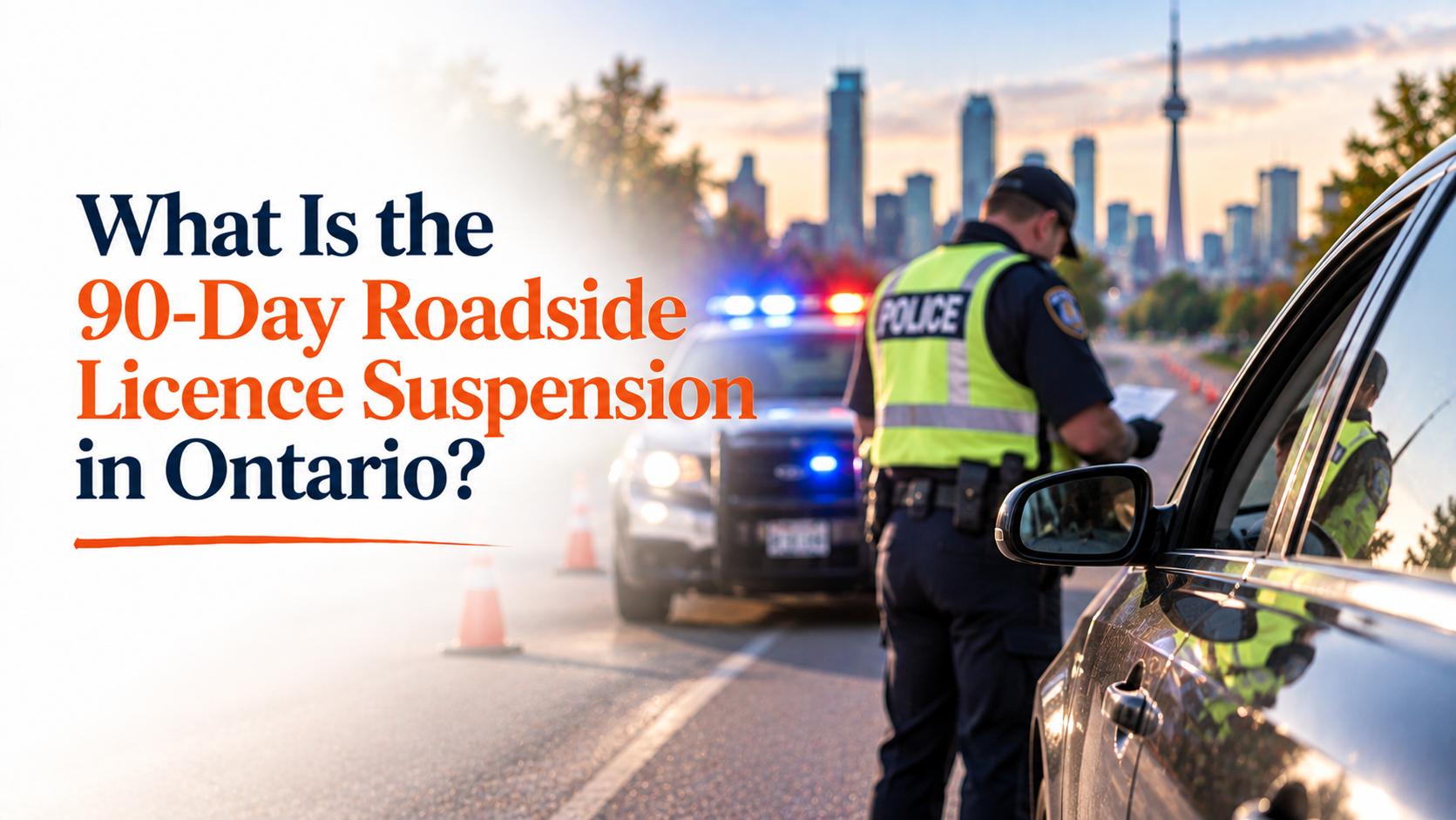
When the threshold is met, the officer takes your licence and gives you a notice of suspension. The suspension takes effect immediately. The ministry lists a seven-day vehicle impoundment with the 90-day suspension. It does not list an impoundment for warn range suspensions. The owner pays towing and storage costs.
For more on what police may ask of you during a stop, see our article on what happens during an impaired driving investigation in Ontario and our guide to refusing a breathalyzer test.
What It Costs
The 90-day suspension carries these government charges, and none of them is waived when the 90 days run out:
- Administrative monetary penalty: $550 for a 90-day suspension under O. Reg. 273/07
- Licence reinstatement fee: $281, paid to ServiceOntario (Ontario.ca)
- Education or treatment program: an 8-hour education course on a first occurrence, and a 16-hour treatment program on a second or third occurrence (Ministry of Transportation)
The penalty is payable in addition to the reinstatement fee, which brings the government charges to $831, before towing, storage and the program. A third occurrence in the 90-day category also brings an ignition interlock condition for six months. These amounts can change, so confirm them with the ministry when you pay. If your suspension has been in place for more than a year, you may also need to retake tests to get your licence back. Details are on the ministry’s reinstatement page.
An administrative suspension also appears on your driving record, and insurers can treat it as a sign of higher risk. Some drivers see premium increases or have a policy cancelled.
Can You Drive During the Suspension?
No. The ministry’s impaired driving penalties list no work exception or hardship licence for the warn range or the 90-day suspension, so assume you cannot drive for any reason while the suspension is in effect (Ministry of Transportation). Driving while suspended is a separate offence with serious consequences, including the possibility of more suspension time, vehicle impoundment and fines. If you are caught, speak to a lawyer before you do anything else.
Can You Challenge It?
You can appeal to the Licence Appeal Tribunal, but the grounds are narrow. Here are the key points:
- Deadline: the deadline to file is the one stated in the decision you receive, and the Tribunal’s appeal form asks you to confirm that you are filing within it (Licence Appeal Tribunal form). It is short, so check it the day you receive your notice
- Fee: $106 per licence (Tribunals Ontario)
- Driving while you wait: filing an appeal does not mean you can drive again. Treat the suspension as in force until you have been told in writing that it has been lifted
- Only two grounds: you must show either that you are not the person the demand was made to, or that a medical reason prevented you from complying (Tribunals Ontario information sheet). For a drug-related suspension, the medical ground is framed differently. You must show that you were not impaired by a drug or a combination of a drug and alcohol, and that a medical condition affected your performance on the evaluation
The tribunal cannot cancel a suspension because it causes you hardship or because you believe the stop was unlawful. Medical appeals need a report from your physician (Ontario forms). Arguments about how the police handled the stop belong in the criminal case, if charges are laid.
How It Relates to a Criminal Charge
The two systems run separately. The suspension comes from Ontario’s Highway Traffic Act and starts right away. A criminal charge comes from the federal Criminal Code, is decided in court, and can lead to its own penalties, including a driving prohibition on conviction. A suspension can apply whether or not the Crown goes ahead with a charge, and the outcome of one does not decide the other. For anyone charged, a criminal defence lawyer can deal with the appeal deadline and the criminal case at the same time.
Local Context
As of June 10, 2026, the Ottawa Police Service had laid 391 impaired-driving-related charges year to date, compared with 327 in the same period of 2025, an increase of 19.5 per cent (Ottawa Police Service).
Key Deadlines at a Glance
- Suspension: takes effect immediately
- Impoundment (90-day suspension): 7 days
- Appeal to the Licence Appeal Tribunal: by the deadline stated in your decision
- Reinstatement: you must apply and pay the fee after the suspension ends, and it does not restore automatically
Getting Legal Help Early
The first days after a roadside suspension are the most important. The appeal deadline on your notice is short, the suspension is already running, and decisions you make at the roadside or the station may affect a later criminal case. LMS Lawyers represents drivers in Ottawa facing impaired driving suspensions and charges. You can contact LMS Lawyers to review your notice, the deadlines and your options.
FAQs
Is the 90-day suspension the same as a criminal conviction?
No. It is an administrative penalty issued by police under the Highway Traffic Act. It is separate from any Criminal Code charge.
Does a warn-range reading cause a 90-day suspension?
No. The warn range leads to suspensions of 7, 14 or 30 days, depending on how many times it has happened within the look-back period, which is now 10 years.
Can I drive to work during the 90 days?
No. The ministry lists no work exception or hardship licence for this suspension.
Does appealing let me drive again?
No. Treat the suspension as in force until you have been told in writing that it has been lifted.
How long do I have to appeal?
The deadline is stated in the decision you receive. It is short, so check it right away.
What can I appeal on?
Only mistaken identity or a medical reason connected to the testing or evaluation.
What does it cost to get my licence back?
A $550 administrative penalty and a $281 reinstatement fee, plus towing and storage charges. You must also complete an 8-hour education course on a first occurrence.
Summary
The 90-day roadside suspension is an immediate administrative penalty for readings of 80 mg or more, failed drug evaluations and refusals. It is separate from any criminal charge and can apply even if charges are dropped. It carries a seven-day vehicle impoundment, a $550 penalty, a $281 reinstatement fee and an education course on a first occurrence, and the ministry lists no work exception. An appeal to the Licence Appeal Tribunal costs $106, has a deadline stated in your decision, and can succeed only on narrow grounds. Warn-range readings lead to shorter suspensions of 7, 14 or 30 days. LMS Lawyers can review your suspension and your options before the appeal deadline passes.
Sources
- Ministry of Transportation: Impaired driving
- Highway Traffic Act, R.S.O. 1990, c. H.8
- O. Reg. 273/07, Administrative Penalties
- Ontario.ca: Reinstate a suspended driver’s licence
- Tribunals Ontario: Application and hearing process
- Tribunals Ontario: Administrative Driver’s Licence Suspension Appeal Information Sheet
- Licence Appeal Tribunal: Notice of Appeal, Administrative Driver’s Licence Suspension
- Ontario forms: Licence Suspension, Applicant’s Medical Information
- Ottawa Police Service: Impaired driving
- Ottawa Police Service: Spring into Safety campaign news release, June 19, 2026
This article is intended for general information purposes only and describes federal and Ontario law as of October 2026. It does not constitute legal advice and does not create a lawyer-client relationship between LMS Lawyers and the reader. For advice specific to your situation, please consult a licensed lawyer.