
Quick Overview
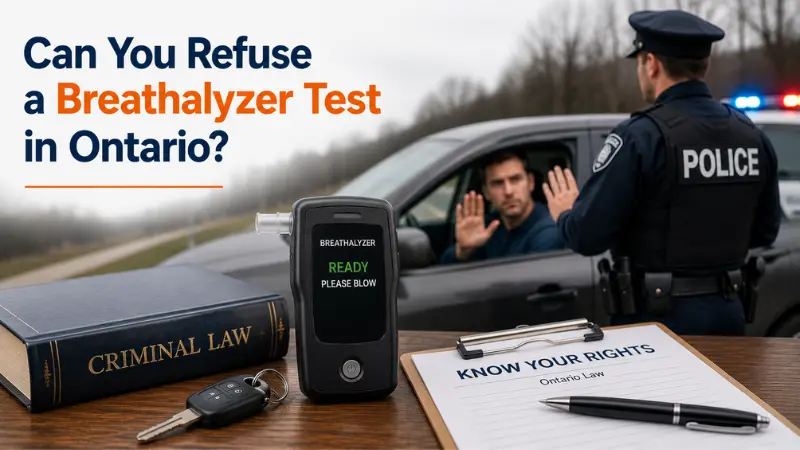
- Refusing a breath sample is its own criminal offence under section 320.15(1) of the Criminal Code, separate from impaired driving itself
- The minimum fine for a first refusal is $2,000, actually higher than the base minimum fine for a standard over 80 conviction
- Refusing doesn’t offer any real advantage. Parliament built the penalties specifically to remove that incentive
- A genuine medical inability to provide breath can count as a reasonable excuse. Fear, nervousness, or wanting to call a lawyer first generally don’t
- Recent Supreme Court and appellate rulings have clarified when police demands are actually valid, and when a driver can retract an initial refusal
- A refusal conviction can trigger serious immigration consequences for non-citizens, sometimes more severe than people expect
Refusing Is Its Own Crime, Not a Loophole
A lot of drivers assume refusing a breath test is some kind of clever workaround, a way to avoid leaving evidence behind. It isn’t. Section 320.15(1) of the Criminal Code makes refusal a standalone criminal offence, entirely separate from impaired driving or an over 80 charge. To convict someone under this section, the Crown has to show a lawful demand was actually made, that the person knew about it, and that they failed or refused to comply without a reasonable excuse.
The mental state required here matters too. In R. v. Emereuwa, the Saskatchewan Court of Appeal held that refusal requires genuine intent, meaning someone who makes a real, honest attempt at providing a sample but simply can’t produce enough breath isn’t automatically guilty. This is worth flagging as an unsettled area. Courts across the country have split on whether the Crown must prove the driver actually intended to refuse or only that they knew a demand had been made, and the question may still reach the Supreme Court. On the view taken in Emereuwa, the Crown has to prove the failure was deliberate.
Why Refusing Doesn’t Actually Help Anyone
This is really the core misconception worth clearing up. Parliament deliberately designed the penalty structure so refusing carries no strategic benefit at all. A standard first-time over 80 conviction starts at a $1,000 minimum fine, and that number only climbs if the driver’s blood alcohol reading was genuinely high, reaching $1,500 for readings between 120 and 159 milligrams, and $2,000 only at 160 or above. Refusal skips that entire sliding scale. A first refusal conviction carries a flat $2,000 minimum fine, immediately matching the penalty reserved for the most intoxicated tier of over 80 offenders, regardless of what someone’s actual BAC might have been.
Everything else lines up identically too. The same permanent criminal record applies. The same escalating jail terms kick in for repeat offences, 30 days minimum for a second conviction, 120 days for a third. A prior over 80 conviction even counts toward that escalation if someone is later convicted of refusal. Mandatory federal driving prohibitions apply with equal severity across the board. There’s genuinely no version of this where refusing comes out ahead.
Two Kinds of Demands, Two Different Sets of Rights
Not every breath demand works the same way, and the legal requirements shift depending on which stage of the investigation someone’s actually in. At the roadside, police rely on an Approved Screening Device under section 320.27, and they can make this demand either because they have reasonable suspicion, or because of a provision called Mandatory Alcohol Screening, which lets them ask for a sample from basically any lawfully stopped driver with no suspicion required at all.
Roadside demands come with a strict immediacy requirement, the sample has to be given right then, and that immediacy is exactly why the right to a lawyer gets temporarily suspended at this stage. Courts have accepted that suspension as reasonable given how brief the detention is.
Once someone’s arrested, whether from a Fail on the roadside device or from independent grounds, everything shifts under section 320.28. This evidentiary demand happens at the station, using a proper breathalyzer machine, and this time full Charter rights are back in play. Police have to inform the driver of their right to counsel, give them a real chance to consult a lawyer, and hold off on testing until that’s happened. Skip that step, and a refusal charged at this stage can genuinely fall apart in court.
What Actually Counts as a Reasonable Excuse
The law does leave room for a defence here, but it’s a narrow one. Courts have consistently accepted genuine physical inability, conditions like severe asthma or COPD that limit lung capacity, or injuries from a collision, a punctured lung, broken ribs, facial trauma, that physically prevent someone from forming a seal on the mouthpiece or sustaining enough breath pressure.
What doesn’t count is basically everything emotional or situational. Fear of the results, general nervousness, frustration with the officer, wanting to wait for a lawyer before blowing into a roadside device, none of that qualifies. Procedurally, this plays out in stages. The defence has to first put the excuse in play by pointing to some credible evidence, medical records, an injury, something real, enough to give it what courts call an air of reality. Once that threshold is met, the reasonable excuse becomes a live issue at trial that the Crown has to answer, rather than something the driver simply asserts and the court accepts.

Changing Your Mind, and Whether It’s Too Late
A recurring situation involves someone who refuses initially, then quickly changes their mind. In R. v. Khandakar, the Ontario Court of Appeal addressed exactly this. A driver refused a roadside demand and was arrested, then a few minutes later, realizing he would be released at the roadside rather than tested at the station, offered to comply after all. The Court set out the governing test rather than deciding the case outright, sending it back for a new trial. It held that a prompt change of mind, still within the same continuous transaction, can undo an initial refusal, though the window for this is tight given how strict the immediacy requirement is. There’s no fixed cutoff, it depends on whether police could still lawfully carry out the test at that moment.
R. v. Breault dealt with a related issue, whether police can demand a sample at all if they don’t actually have the device with them. The Supreme Court ruled they can’t. A demand made while waiting for someone to bring a device over isn’t valid, and a refusal charge built on that kind of demand won’t hold up. This principle has come up repeatedly across recent cases, and it’s a genuine area where the details of how an investigation happened matter as much as the refusal itself, exactly the kind of detail an Ottawa impaired driving lawyer will look at closely.
Private property adds another layer, and the law here shifted recently. In R. v. Singer, police walked up a residential driveway to investigate an impaired driving complaint, approached the vehicle, and then opened the driver’s door. The Supreme Court held that police can rely on the implied licence to step onto a driveway and approach a vehicle to speak with the person inside, but that opening the closed door went further than that licence allowed and breached the driver’s Charter rights. Even so, the Court let the evidence stand and upheld the conviction, so a breach like this does not automatically mean the evidence gets excluded. What it does mean is that the exact steps police take on private property can matter a great deal to how a case plays out.
The Penalties Beyond the Courtroom
A refusal conviction sets off an immediate 90-day licence suspension and a 7-day vehicle impoundment right at the roadside, before any court date even happens. Getting a licence back afterward requires completing Ontario’s “Back on Track” remedial program, a lengthy process involving assessment, education or treatment sessions, and a follow-up evaluation months later, all at the driver’s own cost. An ignition interlock device follows for at least a year after that.
Insurance takes a serious hit too. Standard insurers routinely cancel a policy outright after a refusal conviction, pushing the driver into the Facility Association, Ontario’s insurer of last resort, where premiums can run into the thousands annually for several years.
Immigration Consequences People Often Don’t See Coming
This part surprises a lot of people. Because Bill C-46 raised the maximum penalty for refusal to 10 years if prosecuted by indictment, a refusal conviction now meets the threshold for “serious criminality” under federal immigration law, regardless of how the Crown actually chose to proceed or what sentence was actually handed down. For permanent residents, work permit holders, or anyone without citizenship, this can trigger inadmissibility findings and formal removal proceedings. Whether someone retains any right to appeal a deportation order often comes down to the exact length of any custodial sentence imposed, which makes the sentencing stage genuinely high stakes for non-citizens facing this charge. This is exactly the kind of overlapping consequence that makes talking to an Ottawa impaired driving lawyer early on so important, since the criminal penalties are rarely the whole picture here.
FAQs
Is it better to refuse a breath test than to fail it?
No. The mandatory minimum fine for refusal is actually higher than the base fine for a standard over 80 conviction, and every other penalty applies with equal severity.
Can I refuse because I want to speak to a lawyer first?
Not at the roadside stage. The right to counsel is suspended during initial screening, so wanting to call a lawyer first isn’t a recognized excuse for refusing.
What counts as a legitimate reason to refuse?
Genuine physical inability, a medical condition or injury that actually prevents providing an adequate breath sample. Fear or nervousness doesn’t qualify.
Can I change my mind after refusing?
Sometimes, if it happens quickly enough that police could still lawfully carry out the test. There’s no fixed time limit, and courts look closely at the specific circumstances.
Does a refusal charge affect immigration status?
It can. A refusal conviction can meet the threshold for serious criminality under immigration law, which may lead to inadmissibility for non-citizens.
Summary
Refusing a breathalyzer test in Ontario isn’t a loophole, it’s its own criminal offence, and one that Parliament deliberately structured to carry penalties equal to or greater than an actual impaired driving conviction. The type of demand, roadside versus evidentiary, changes what rights apply, and only a genuine physical inability tends to count as a valid excuse for non-compliance. Recent court rulings continue to shape when a demand is actually valid and when a change of mind can undo an initial refusal. Beyond the criminal penalties, administrative sanctions, insurance consequences, and potential immigration fallout all follow close behind, making this a charge with consequences that extend well past the courtroom.
This article is intended for general information purposes only and does not constitute legal advice. It does not create a lawyer-client relationship between LMS Lawyers and the reader. For advice specific to your situation, please consult a licensed lawyer.