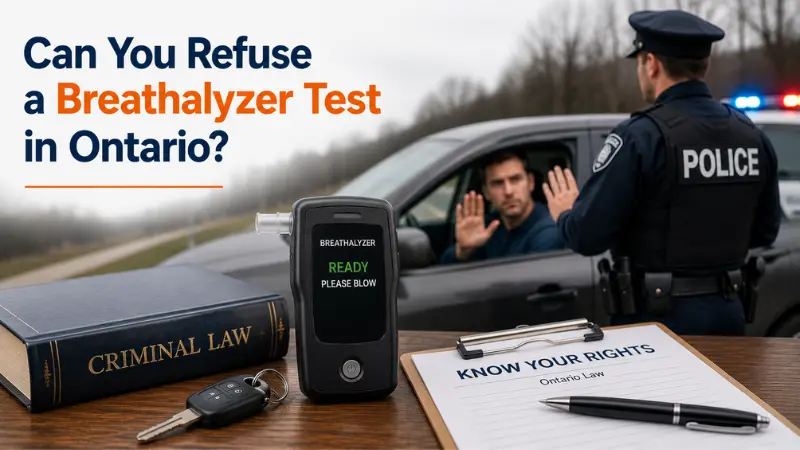
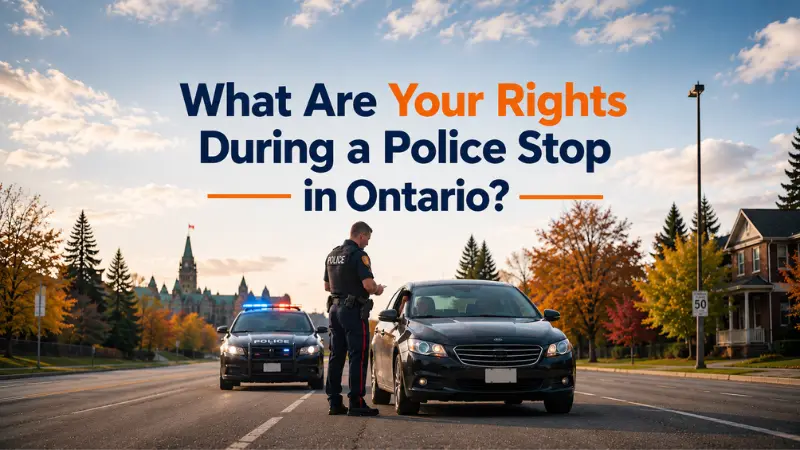

Getting stopped by police, even briefly, can leave most people unsure of what they are actually required to do. Do you have to answer questions? Do you have to show ID? At what point does a stop become a detention? These are common questions, and the answers are grounded in specific sections of the Canadian Charter of Rights and Freedoms along with Ontario provincial law.
This article breaks down what the law actually says about police stops in Ontario, based on the Charter, the Highway Traffic Act, and recent court decisions.

Questioning, Detention, and Arrest Are Not the Same Thing
Not every interaction with police carries the same legal weight. Canadian law recognizes three distinct stages, and each one triggers different rights.
Voluntary questioning happens when police approach someone in public to ask general questions. If a person is free to walk away and simply chooses to speak with police, no Charter rights are engaged yet. A brief request for ID where nothing is compelling the person to stay does not meet the legal threshold of a detention.
Detention is different. It occurs when a person’s freedom of movement is restrained, either physically or psychologically, by police authority. The Supreme Court of Canada set out the test for this in R. v. Grant, which looks at how the encounter started, the tone and conduct of the officers involved, and the personal characteristics of the individual, including age and prior experience with the justice system. Once a detention occurs, Section 9 and Section 10 of the Charter apply immediately.
Arrest is the most serious stage. It happens when police physically take a person into custody, or when they use clear words of arrest and the person submits to that authority . An arrest requires police to have reasonable grounds, not just suspicion, and it activates the full set of rights under Section 10, including the right to be told why and the right to speak with a lawyer without delay.
What You Are Actually Required to Show ID For
There is no general law in Canada requiring people to carry identification or hand it over on request. What you are required to provide depends entirely on the situation.
If you are driving, Ontario’s Highway Traffic Act gives police the authority to ask for your licence, registration, and proof of insurance. This obligation exists because driving is a licensed activity. That said, this power has limits. In R. v. McColman, the Supreme Court ruled that police cannot rely on random stop powers to pull someone over once their vehicle is on private property, “since the random stop powers under the Highway Traffic Act only apply while the vehicle is on a highway, not once it has pulled onto private property.
Passengers are generally not required to identify themselves, since they are not the ones operating the vehicle. Pedestrians and people at home are under the same protection, unless they are being issued a ticket under the Provincial Offences Act, in which case providing a name, address, and date of birth becomes mandatory.
Ontario also has specific rules under Regulation 58/16 that limit when police can ask for identifying information during general community interactions, commonly referred to as street checks. When this regulation applies, officers are required to explain why they are asking, tell the person they can refuse, and provide a receipt of the interaction.

The Right to Remain Silent
The right to silence means you are not obligated to answer police questions, regardless of whether you are a witness, a person of interest, or someone under arrest. Any statement given to police only becomes usable in court if the Crown can prove it was made voluntarily, without threats, pressure, or trickery.
In R. v. Tessier, the Supreme Court clarified that police are only required to formally caution someone about their right to silence once that person becomes a suspect, not during general witness questioning. If a suspect is not cautioned, that absence works in their favour as evidence the statement may not have been voluntary, though it is not automatically thrown out.
It is worth noting that the right to silence does not remove the specific ID obligations mentioned earlier, and police are allowed to continue asking questions even after someone says they do not wish to speak, as long as the questioning does not cross into oppressive conduct.
The Right to Speak With a Lawyer
Once a person is detained or arrested, police must immediately tell them they have the right to speak with a lawyer, including free access to duty counsel through Legal Aid. Once that right is asserted, police are required to give a real opportunity for a private conversation with a lawyer and must hold off on further questioning until that happens.
There is an important distinction between duty counsel, which is available quickly by phone, and a private lawyer of someone’s own choosing. Courts have made clear that police cannot pressure a person into giving up on their own lawyer, or make it seem like duty counsel is the only option. At the same time, the person must make reasonable efforts to reach their lawyer within a reasonable time. If that lawyer cannot be reached, speaking with duty counsel may become the practical next step.
In most cases, one consultation with a lawyer satisfies this right. But if circumstances change significantly, such as new charges being introduced or clear signs the person misunderstood their rights, a second consultation may be required, as confirmed by the Supreme Court in R. v. Lafrance.
What Happens If These Rights Are Not Respected
When police breach a person’s rights under Section 9 or 10 of the Charter, courts can exclude the evidence gathered as a result under Section 24(2). Whether evidence gets excluded depends on how serious the breach was, how much it affected the person’s privacy or dignity, and the public interest in resolving the case on its merits.
This is why the way a stop unfolds, not just its outcome, often becomes a central issue in criminal proceedings.
Why This Matters
Understanding these distinctions matters because rights are only useful if people know when they apply. A stop that starts as a casual conversation can shift into a detention very quickly, and knowing where that line sits can affect how someone chooses to respond.
If a situation moves beyond a routine stop and charges are laid, speaking with a criminal lawyer in Ottawa early on can make a real difference in how the case is handled from that point forward. LMS Lawyers has represented clients across a wide range of criminal matters in Ottawa, and our team regularly works through exactly these kinds of Charter issues in court.
Beyond criminal defence, our Ottawa office also has family lawyers, real estate lawyers, and corporate lawyers ready to help with whatever legal question comes next.
If you are dealing with a criminal matter in Ottawa and want to understand your options, reach out to our criminal lawyers in Ottawa for a consultation.