

Quick Overview
- A first appearance is administrative, not a trial. No evidence is heard, no verdict is reached
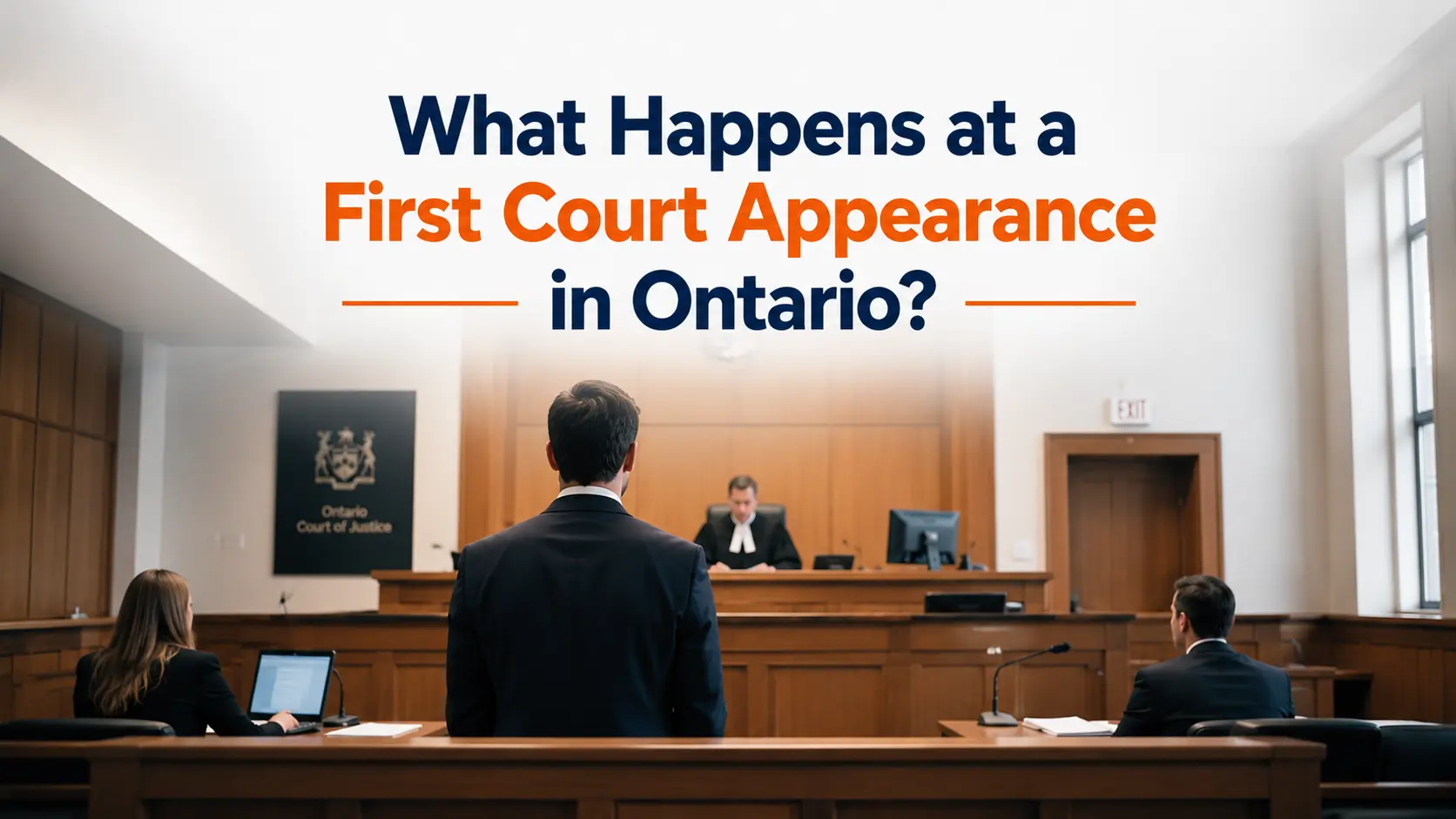
- It takes place in the Ontario Court of Justice, generally before a Justice of the Peace
- The court confirms legal representation, and the Crown usually provides initial disclosure at this stage
- The matter is almost always adjourned to a later date
- Bail and release conditions from the arrest stay in effect throughout, they don’t pause
- Missing the date can mean a bench warrant and a separate criminal charge, even if the original case is later withdrawn
First Appearance Is Not a Trial
A judge hearing evidence. A decision on guilt reached right there in the courtroom. That’s the image many people bring to their first court date, and it isn’t accurate. What actually happens is closer to bookkeeping than adjudication. The court confirms who is representing the accused, checks where disclosure stands, and sets the next date. The merits of the case aren’t touched at all.
There’s no witness testimony and no cross-examination at this stage. A preliminary inquiry works differently. It’s an evidentiary hearing, reserved for certain serious indictable offences, where a court actually weighs whether there’s enough evidence to justify a trial. A first appearance comes well before any of that becomes relevant.
Where This Takes Place
Every adult first appearance in Ontario begins in the Ontario Court of Justice, no matter how serious the charge is. Cases eventually destined for the Superior Court of Justice, including the most serious indictable matters, still start out here for these early administrative steps.
A Justice of the Peace usually presides, not a trial judge. Keeping the docket moving, confirming basic details, granting adjournments so files can progress, that’s the substance of the role at this stage. The Superior Court only enters the picture later on, typically when a charge falls under its exclusive jurisdiction, when the accused elects trial there, or for a bail review.
What Happens During the Appearance
Release paperwork sets the date, time, and courthouse, whether that’s an Appearance Notice, an Undertaking, or a Release Order. Arriving around thirty minutes early is the standard advice, enough time to clear security and locate the right courtroom. Names get called off a docket in the order cases are scheduled.
When a name comes up, representation gets sorted out first. Has the accused retained a lawyer? Are they planning to self-represent? Do they need more time? Someone without a lawyer is typically pointed toward Duty Counsel, a free service sitting right at the courthouse for immediate advice. Disclosure tends to follow shortly after, the Crown’s initial evidence package from the investigation, often paired with a Charge Screening Form laying out the charges, how the Crown intends to proceed, and its early position on sentencing if things end in a guilty plea.
An adjournment follows almost without exception. Nothing gets resolved on this date, so the file moves to a new one, giving the defence time to work through disclosure properly, retain or consult a lawyer, and set up a Crown Pre-Trial meeting to discuss where the case might land.
Does the Accused Have to Show Up in Person?
Usually, yes. But there’s a genuine exception for anyone represented by counsel. Section 650.01 of the Criminal Code allows an accused to file a Designation of Counsel, which lets their lawyer appear for most proceedings, first appearances included, without the accused being physically present. Guilty pleas and sentencing sit outside this exception. For a routine date like this, having counsel appear is treated the same as the accused showing up themselves.
Licensed paralegals can also step in as agents for less serious summary conviction matters, within boundaries the Law Society of Ontario has set. Criminal lawyers in Ottawa handle these administrative appearances on a client’s behalf all the time, which spares clients the trouble of taking time off work for something that’s purely procedural on paper.

Bail Conditions Don’t Pause for This
Conditions set at release, whether through an Undertaking, a Release Order, or a full bail hearing, don’t change or pause because of a first appearance. They carry through this stage and stay in force for the rest of the pre-trial process.
A surety’s obligations continue right alongside the accused’s own. Making sure the accused shows up and sticks to every condition, that’s the surety’s job throughout. If a date gets missed or a condition gets broken, the Crown can pursue an estreatment hearing, where a judge decides how much of the pledged bail amount is forfeited. Breaching a condition is also its own criminal offence, separate from the original charge, and it tends to lead straight to a new arrest and a much harder road to release the second time around.
Electing the Mode of Trial
Certain more serious offences give the accused a choice in how the trial proceeds: a provincial court judge alone, a Superior Court judge alone, or a Superior Court judge sitting with a jury. Electing the mode of trial is what this decision is called, and it almost never happens at the first appearance. Full disclosure, and usually a Crown Pre-Trial conversation, need to happen first before this choice can really be made properly, so courts tend to push the actual election further down the line.
The Consequences of Missing a First Appearance
Not showing up carries genuine consequences. If a name is called and the accused isn’t there, the Justice of the Peace can issue a bench warrant, which authorizes police to locate and arrest that person and bring them before the court.
There’s a softer option too. When a lawyer is present and can account for the absence, the court sometimes issues a bench warrant with discretion instead. The arrest gets held off, a new date gets set, and the accused gets one more opportunity to show up. Miss that date as well, and the discretion disappears, the warrant simply gets executed.
A separate charge can come out of this too, under section 145 of the Criminal Code for failing to appear. That conviction goes on someone’s criminal record and stays there regardless of what happens with the original matter, even if it’s later withdrawn or ends in an acquittal.
Recent Procedural Changes
The process around first appearances has shifted a great deal in recent years. Video appearances are now permanent fixtures for a lot of out-of-custody matters in the Ontario Court of Justice, and the court has moved toward a cloud-based system for sharing disclosure and case materials digitally, rather than relying on paper files.
One notable shift: a practice direction now sets a 12-week adjournment period from the first appearance for represented, out-of-custody accused persons, a real departure from the two-to-four-week adjournments that used to be typical. Fewer administrative court dates while cases still move toward resolution or trial more efficiently, that’s the reasoning behind it. Mid-2026 brought a further change too: for new files, matters are now capped at three case management appearances before they must move forward, a shift connected to the trial delay standards set out in R. v. Jordan.
Given how frequently these rules keep changing, an experienced criminal defence lawyer in Ottawa can make a genuine difference in keeping a case on track and making sure no deadline gets missed along the way.
FAQs
Do I need a lawyer for my first court appearance?
Not strictly required, but it helps. Without one, the court will direct you to Duty Counsel for free advice at the courthouse.
Will I find out if I’m going to jail at my first appearance?
No. This stage is purely administrative. Sentencing only comes up after a guilty plea or a trial verdict, both well down the road.
Can my lawyer attend court on my behalf?
Often, yes. With a lawyer retained and a Designation of Counsel filed, they can appear for most routine dates, including the first appearance.
Does disclosure stop if my case gets adjourned?
No. It’s an ongoing obligation, so anything missing at the first appearance should still be provided as things move forward.
What if I genuinely forgot my court date?
It can still lead to a bench warrant and a separate failure to appear charge. Contacting a lawyer right away beats waiting to see how things unfold.
Summary
A first appearance in Ontario marks the beginning of the criminal court process, not a trial. It happens in the Ontario Court of Justice, confirms legal representation, gets disclosure started, and wraps up with an adjournment to a later date. Bail conditions stay active the entire time, missing the date risks a bench warrant and a new charge, and changes like the 12-week adjournment rule are reshaping how quickly these matters move through the system now. Knowing what to actually expect at this stage takes a good deal of the uncertainty out of what comes next.
This article is intended for general information purposes only and does not constitute legal advice. It does not create a lawyer-client relationship between LMS Lawyers and the reader. For advice specific to your situation, please consult a licensed lawyer.